
The Playdium opened in the former Penn Square Theater on the north side of Euclid Avenue just west of the Pennsylvania Railroad trestle over Euclid and East 55th on Christmas Eve in 1945. Owner Norman Khoury, born in Suwaida, Syria, in 1905, rose to become one of Cleveland’s leading club operators in the 1930s and 1940s. At the Playdium, he started with extravagant floor shows before eventually settling on a Harlem-style policy for booking musical talent. The Playdium had a short run as a popular music venue that attracted biracial patronage. It was located directly across the street from another short-lived Harlem-style venue, the Metropolitan Theatre. The inclusion of “Cafe Society Midtown” in its name in some ads probably sought to connect the club in people’s minds to New York’s famed Cafe Society because it had no relation to the Green Book–listed Cafe Society in Glenville. Disparaged by the Plain Dealer as the city’s “Clip-Joint King,” Khoury ran as many as 24 nightclubs in Cleveland in the 1940s, but when the Ohio Liquor Board started a crusade to shut down him down, he closed down many of his clubs and began spending long periods of time away from the city, including in Las Vegas, where he opened a casino. The Playdium disappears from newspapers in 1948, consistent with the emergence of Khoury’s difficulties.
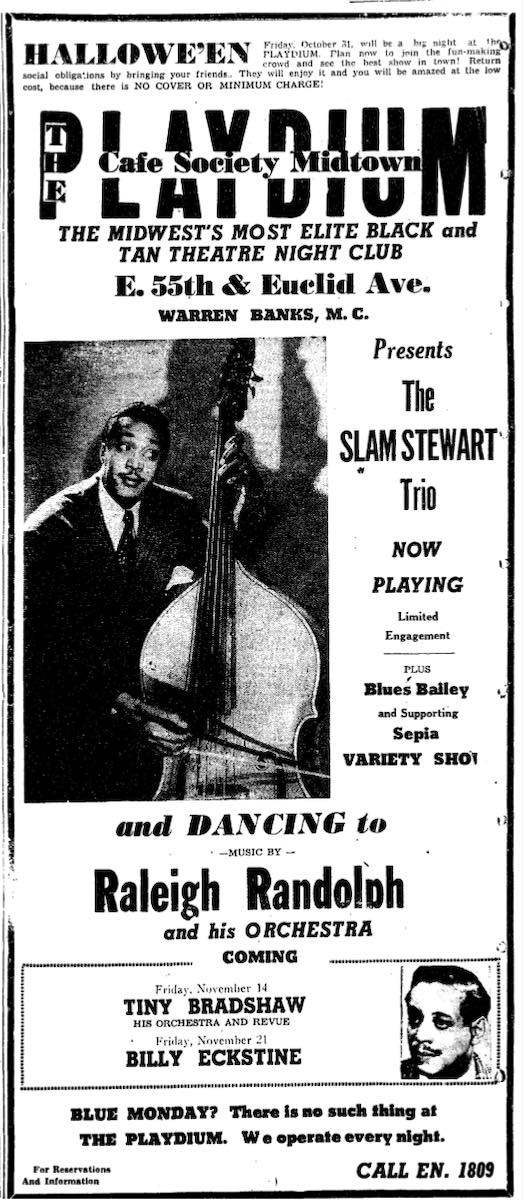
The Playdium advertised itself as the most elite Black nightclub in Cleveland. The nightclub had a strong connection with New York entertainment clubs, demonstrated by the many singers, orchestras, and comedy acts that moved through the club. One of the most prominent examples is the performance by Maurice Rocco, a Broadway pianist and performer. Rocco was born and raised in Oxford, Ohio. Rocco started performing on the WLW radio station. He toured radio shows across the country and then stopped by the Playdium in October 1947. His work was heard by the Rogers Sisters at the Kit Kat Club in New York, who were so impressed he hired Rocco and created a new act for him to perform live. Rocco also performed in Zanzibar in New York before acting for Paramount Pictures. Rocco spent some time in Cleveland performing, but he was also jailed in the city over Christmas of 1957 for writing bad checks. Raleigh Randolph’s orchestra performed the same night. Raleigh Randolph’s orchestra came up in Columbus, Ohio, and was inducted into the Jazz Hall of Fame in 1983.
The Playdium sponsored fan clubs of big artists who performed there. In November 1947, the Playdium advertised in the Call and Post that people could become members of the Billy Eckstine club by filling out a small survey, sending their name and address to the theater. Members of the Billy Eckstine Club would only have to pay half price for tickets for his upcoming performance later that month, with choice of seating, and free prizes would be distributed by Eckstine during his performance to people in the group. At the time that Eckstine performed at the Playdium, he was still a rising star who had just been announced as “The Outstanding New Singing Star of the Year” in an annual poll conducted by Esquire magazine. In previous years, this award had been honored by Frank Sinatra and Perry Como. Eckstine rose to fame in the Chicago jazz scene and, in 1944, he created his own band called the Billy Eckstine Orchestra, credited as the first bebop band. In 1946, a year before performing at the Playdium, the Billy Eckstine Orchestra broke into the film industry, starring in the musical film Rhythm in a Riff. During the late 1940s and 1950s, the Billy Eckstine Orchestra performed in clubs all over the country but spent most of their time around New York City.
Pearl Bailey also performed at the Playdium. Bailey was a jazz performer and dancer who started out in Philadelphia’s Black nightclubs in the 1930s. She eventually moved to perform along the East Coast. In 1946, the same year she performed at the Playdium, Bailey made her Broadway debut in St. Louis Woman. In 1967, Bailey won a Tony Award for her role as Dolly in an all-Black version of Hey Dolly that Bailey and Cab Calloway headlined. Bailey was known for selling out seats on Broadway. In 1971, Bailey got an ABC network show called The Pearl Bailey Show, where she had different performers on, some notable performers being Lucille Ball, Bing Crosby, and Louis Armstrong. Armstrong performed on the show in January 1971 and died only seven months later; this show taping is credited as one of his final recorded performances. Bailey was a voice actor, author of several books, and performed at the white house for different world leaders.
Marian Bruce, a CBS prize-winning songstress from the famous New York club Le Ruban Bleu. An ad for her performance ran in the Call and Post newspaper on September 6, 1947. Marian Bruce was an activist who had the first all-Black show to be presented in a Miami Beach nightclub. Outside of her music, Bruce was an associate of Dr. Martin Luther King Jr. and helped with state- and federal-level political campaigns. From 1977 to 1979, she served as a New York City Commissioner of Human Rights. Opening for Bruce was Johnny Powell and his Paramount recording orchestra as well as the Sepia Variety Show, a comedy dance team from Duke Ellington’s Ork. Johnny Powell was very active in Cleveland but also toured New York and other major cities.
In June 1947, the Cleveland Press wrote that the Playdium had been “nearly deserted” for the past two years. The article acknowledges that Joe Feorla and his orchestra had just performed in the Playdium, but believes that the owner, Norman Khoury, had been dealing with some troubles for the previous two years and was now trying to reopen and revamp the Playdium. The Playdium lost its liquor permit in 1944, and its appeal was denied in 1946, causing attendance to drop off. Owner Khoury told the Ohio State Liquor Board that he had poured money into the club, but he chose to close the Playdium and reopen it in 1947. There was a short period in June 1948 when the Playdium’s liquor license was at stake. However, during the closing and re-opening of the club, there were talented jazz performers and stars who performed at the club. The Playdium cannot be found in any newspapers after 1948, but in the club’s final year, there were some incredible, talented performers on the Playdium stage.
Resources
- Esztherhas, Joseph. “Ex-Clip-Joint King Khoury Laid to Rest with Stars.” Cleveland Plain Dealer. December 15, 1967.
- “Liquor Board Denies Khoury’s Playdium Appeal.” Cleveland Press, February 6, 1946.
- “Marcicio Rocco Coming to Playdium Tuesday Night.” Call and Post, October 4, 1947.
- “Out at the Playdium.” Cleveland Press. June 28, 1947.
- “Playdium Liquor License at Stake.” Cleveland Press. June 10, 1948.
- “Playdium Showings This Week,” Call and Post. September 6, 1947.
- “The Playdium Sponsors Fan Club to Welcome Eckstine November 21.” Call and Post. November 1, 1947.
- “Weekend Safe Crackers Get $750 in Playdium Nighttime Receipts.” Call and Post. November 8, 1947.
My name is Norman Rahal, Norman Khoury was my grandfather Dorothy was his eldest
Child,
Any info you can share would be appreciated