
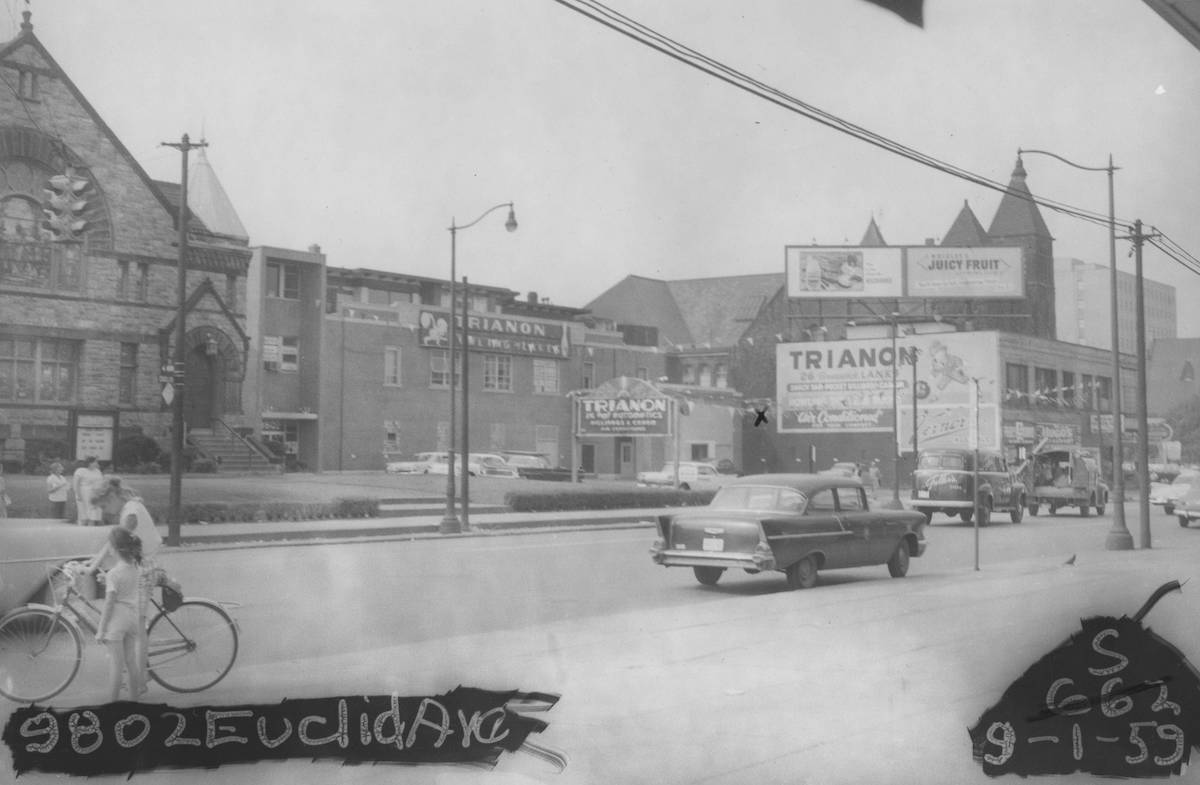
The Trianon Ballroom, which operated under that name from 1934 to 1941, was a mixed venue for most of this period. Located on Euclid Avenue near East 100th Street on what is now the western addition to East Mount Zion Baptist Church, the 4,000-person capacity building dated to 1920 as the Crystal Slipper, a dance club managed by Phil Selznick. The club was on the property where Dr. Worthy S. Streator had previously lived in one of Euclid Avenue’s “Millionaires’ Row” mansions. At that time, the Crystal Slipper prohibited Black patrons from attending. The Trianon name was adopted in October 1934, borrowed from Chicago’s famous ballroom to give the establishment more cultural resonance. In May 1935, the Trianon faced controversy over its discriminatory admission policy. The unsegregated Cleveland post office held a fundraiser dance at the ballroom and protested when Black workers and their families were denied admittance by a panicked management. Seeking to avoid lawsuits and legal trouble with the city, the Trianon agreed to grant those who paid tickets the right to attend any event on Wednesday nights for the remainder of May.
In a further sign of the establishment’s changing policies, a limited number of “colored acts” were allowed to perform, and they increased in frequency over the years. The second of these was musician Chick Webb and his band on July 22, 1936. In an advertisement for the show in the Call and Post, the Trianon management stated that “If the order, both in and outside is what it should be,” there would be more events open to African Americans. The language clearly was racially charged and put the burden for future admission on Black patrons. Webb died less than three years later of Pott’s disease (tuberculosis of the spine) on June 16, 1939, at only 34. Despite his declining health, he continued to perform to make sure his bandmates had enough to eat during the Depression. He was a well-loved member of the jazz and swing community, and his death was a major loss to the scene. Ella Fitzgerald, then a member of Webb’s band, took over the role of band leader and returned to perform at the Trianon in 1940 before embarking on her illustrious solo career.
On December 18, 1938, less than a month after big band legend Duke Ellington performed there, the Trianon became embroiled in another incident over racial exclusion. William Colquist, a city dance hall inspector, was arrested for refusing admission to a group of five Black attendees at a Count Basie dance they were entitled to attend. Colquist reportedly blocked them at the door, telling them, “this is no mixed dance.” The charges were brought forward by Andrew Lee, one of the five attendees. It is unclear how the case was resolved, but the incident shows a major shift in operations from just three years prior.
Events continued into the early the 1940s. The Cleveland Press reported that Benny Goodman, “the King of Swing,” performed at the Trianon on Sunday, November 24, 1940. The appearance was among Goodman’s first after a year-long hiatus while he recovered from an operation. Goodman, the son of Russian Jewish immigrants, is often credited with helping to “mainstream” jazz for white audiences. Unfortunately for its patrons, in May 1941, Charley Horvath, the Trianon’s owner, announced that the ballroom would become a bowling alley. Horvath had previously bought out one of the Trianon’s ballroom competitors and converted it into an indoor skating rink. Renamed Trianon Lanes, the former ballroom remained open until 1978.
Other Trianon ballrooms continued to operate in Ohio and appeared in advertisements in Cleveland newspapers. These were not related to the Cleveland Trianon except insofar that they, too, borrowed from the Chicago namesake. On February 25, 1944, the well-known International Sweethearts of Rhythm performed on stage at the Trianon in Toledo. According to Syncopated Times, “the word ‘International’ denoted its diverse ethnic makeup, including African American, Latin, Asian, Jewish, Hawaiian, White and Native American women.” During its run, the band was the most famous of its kind in the country. They traveled the country in live-in buses with amenities that wouldn’t be accessible to all members in many parts of the country due to segregation. An ad in the Call and Post named two bandmembers, Ernestine “Tiny” Davis, a blues singer, and Evelyn McGee (erroneously appearing as McGhee in the paper), a standout vocalist. The Sweethearts’ shows were known for lasting several hours, and the ad promised dancing from 9:30 p.m. until 2 a.m. Had the Trianon in Cleveland remained open, it seems likely that the group might also have played there. The ballroom’s brief run as a prestigious big band hall was cut short despite its popularity.
Resources
- “Benny Goodman Will Bring Great Swing Band to Trianon Ballroom Sunday Night.” The Cleveland Press. November 22, 1940.
- “Chick Webb to Play at Trianon Ballroom Wed.” Call & Post. July 16, 1936.
- “Cleveland Album.” Cleveland Plain Dealer. September 20, 1959.
- “Cleveland’s Biggest Halloween & Mask Ball Carnivall.” Cleveland Plain Dealer. October 28, 1934.
- “Dance Trianon – Ella Fitzgerald.” Call & Post. August 17, 1940.
- “Duke Ellington to Play Trianon November 25th.” Call & Post. November 24, 1938.
- “Five Refused Admission to ‘White’ Count Basie Dance; Dance Inspector Arrested.” Call & Post. December 22, 1938.
- “Letter Carriers Stop Efforts to Discriminate at their Dances.” Call & Post. May 4, 1935.
- “The International Sweethearts of Rhythm, 1937-49.” The Syncopated Times. November 30, 2022.
- “The Musical Novelty of the Century.” Call & Post. February 19, 1944.